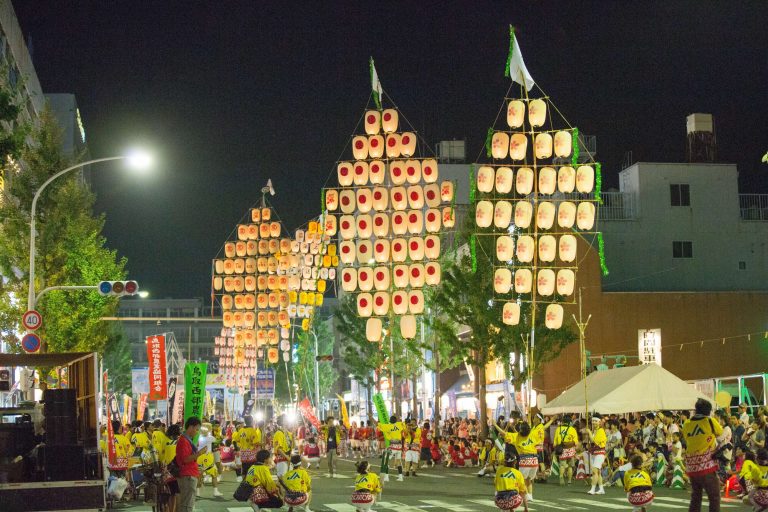




On the evening of 14 August 2026, some 3,425 dancers move through the centre of Tottori, each turning a paper umbrella hung with thirty bells above their head. The Issei Kasa Odori – the mass umbrella dance – runs in two sessions, from 17:00 and from 19:00, along a circuit of the main streets: Wakasa-kaido, Katahara-dori, Chizu-kaido, Taiheisen-dori and the road in front of the station. It is free to watch from anywhere along the route, with no paid seating. This is the 62nd edition. The night before, 13 August, a smaller event called Suzukko Odori runs from 18:00 at Fumon Square outside JR Tottori Station.
What You Are Actually Looking At
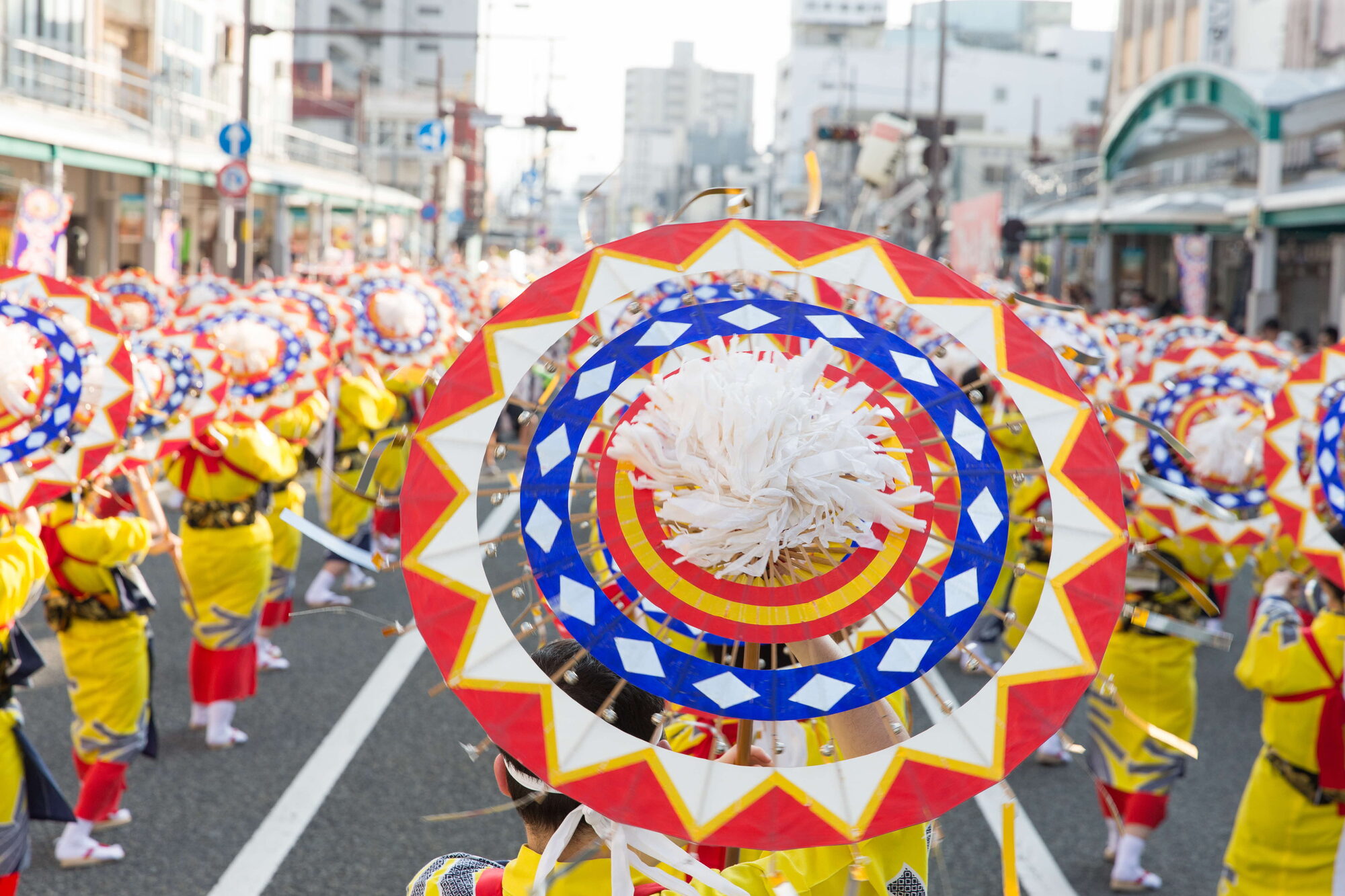
The sound arrives before the sight. Each umbrella carries thirty bells fixed partway down the ribs, so when three thousand of them turn together the effect is not individual jingling but a continuous metallic layer sitting under the drums. Stand on a corner where the route turns and you feel it as much as hear it.
The umbrellas themselves are made objects worth looking at closely. Each is about 80cm across and 120cm long, built on a bamboo frame with washi paper painted red and blue and hung with gold and silver streamers. The colours are not decorative in the arbitrary sense – the organisers assign each one a meaning. The red and white on the outside stand for the Tottori Sand Dunes; the blue for the Sea of Japan; the silver diamonds for fish breaking the surface; the red and gold at the centre for the crowd and the dance drawing together into one ring. The white paper at the very top is the prayer for rain.
Because the umbrellas spin under the street lights, what you see from the roadside is less a parade passing than a single surface of colour rotating slowly along the whole length of the street.
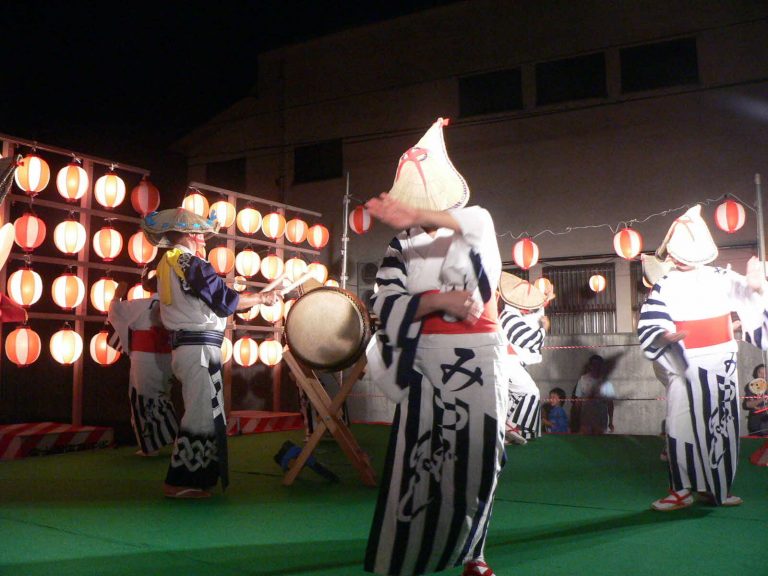
The implement used on the eve of the festival is not an umbrella at all. Suzukko are broad, paddle-shaped boards fitted with six bells each, held one in either hand. They were devised in 2005 and entered the festival at the 42nd edition the following year – a relatively new addition. Because that evening is confined to the square by the station, the dancers are much closer to you than they are on the streets the following night, which ma
kes it the easier of the two to see for the first time.
A Tradition Deliberately Rebuilt
The dance is not ancient in its current form, and the way it was made is the interesting part. Eastern Tottori has a folk tradition called Inaba no Kasa Odori, danced with a large, heavy decorated umbrella – 110cm across and 160cm long – and it takes training. In 1961 the city launched a festival alongside the annual rites of Hijiri Shrine and Omori Shrine, intended to support local commerce. The problem was that its centrepiece could not be danced by ordinary residents.
So the mayor of the time, Isamu Takada, asked a man named Ryuzo Takayama from the Yokomakura district to build a version anyone could learn. Takayama completed the choreography to a song called Kinanse-bushi, and it was first performed in 1964 at the ceremony for the new city hall. From 1965 it became the festival's dance. The name was chosen by public competition; shanshan refers both to hot spring water bubbling up – Tottori has springs in the city centre – and to the sound of the bells. The repertoire has grown since: a second piece was added in 1970, and there are now four.
The result is a festival where the barrier to joining is deliberately low, which is unusual among Japanese folk performing arts and is why the streets fill rather than the stands. In 2014, at the 50th edition, the event set a Guinness World Records title for the largest umbrella dance.
Rain Stops This One
The umbrellas are paper, and rain damages them, so the organisers do not dance through it. Even light rain or drizzle will interrupt or cancel the main dance. If rain is forecast, the promotion association and its contractors confer in advance and announce whether it will go ahead. This is not unhelpfulness – it is how the festival protects the objects it is built around, and knowing that makes a cancellation easier to accept.
Note also that in 2026 the organisers are not running the class divisions, the beauty judging or the basic-dance contest that appear in some years. The dance goes ahead as a mass event without the competitive layer.
The Fireworks Are A Separate Event
One thing catches visitors out. The Shimin Noryo Hanabi Taikai on 15 August – the 73rd edition, about 10,000 shells from 19:50 at the Chiyo-gawara riverside sports ground – is organised by a newspaper company, not by the festival association, and it is on the night after the dance. If you want both, you need two evenings in Tottori. The display has its own origin: it began in 1953 to mark the merger of Tottori City with fourteen villages, and to give thanks for the reconstruction of the Sendai River after three floods in the Taisho era, timed to the sending-off of spirits at Obon. It is cancelled in bad weather with no postponement.
- Dates: 13 August 2026 (eve, Suzukko Odori) / 14 August (Issei Kasa Odori). 62nd edition
- Times: Eve 18:00-21:00. Main dance: first session 17:00-18:50, second 19:00-21:00
- Venues: Eve: Fumon Square and Bird Hat by JR Tottori Station. Main: Wakasa-kaido, Katahara-dori, Chizu-kaido, Taiheisen-dori, station road
- Admission: Free to watch from anywhere along the route. No paid seating
- Scale: About 3,425 dancers (2026, provisional). Each umbrella carries thirty bells
- If it rains: Even light rain or drizzle interrupts or cancels the main dance, because it damages the paper umbrellas. When rain is forecast, the decision is made and announced in advance
- Fireworks: Separate event, 15 August, from 19:50, about 10,000 shells, Chiyo-gawara sports ground. Organised by Shin Nihonkai Shimbun. Cancelled in bad weather with no postponement
- Record: Set a Guinness World Records title for the largest umbrella dance in 2014, at the 50th edition
- Access: Central Tottori, walkable from JR Tottori Station. Fireworks ground about 15 min on foot, with shuttle buses
- Official Info: tottori-shanshan.jp / hanabi-nihonkai.com (fireworks)
Combining It With The Rest Of Tottori
Tottori is the least populous prefecture in Japan and sees comparatively few overseas visitors, which is much of its appeal in mid-August: this is a major festival that has not been reshaped around tourism. The Tottori Sand Dunes – the largest in Japan, and the image on the umbrellas – are a short bus ride from the station, and the Sea of Japan coast either side of the city is dramatic and largely undeveloped.
Sources: Tottori Shanshan Festival Promotion Association, Tottori City Tourism and Convention Association, Shin Nihonkai Shimbun #WestGoldenRoute #Tottori #Festival #Nukumori © Tottori Pref.