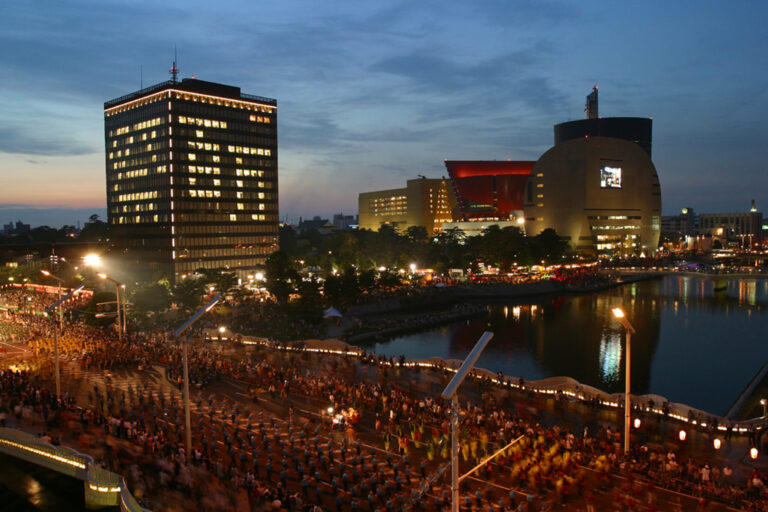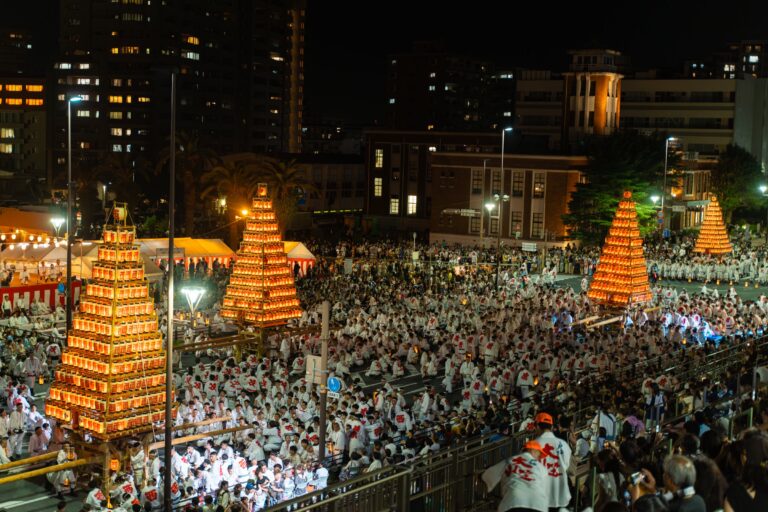




From 23 October to 3 November 2026, the grounds around the keep of Kokura Castle are lit by bamboo lanterns – the organisers work to a target of 30,000. Each one is a length of bamboo with holes bored through it and a light set inside, so what reaches you is a pattern rather than a glow. At this scale the ground reads less like an illumination than like a field of constellations. This is the eighth edition.
THE REASON IT EXISTS
The origin is what separates this from every other light event in Japan. Kitakyushu has one of the largest areas of bamboo forest in the country, and bamboo does not stay where it is planted. As groves are abandoned – the growers age out, no one takes over – the bamboo spreads into the surrounding woodland and replaces it. Because bamboo rhizomes sit in roughly the top 50 centimetres of soil rather than anchoring deep, the hillsides it takes over lose their capacity to hold water, and the landslide risk rises. The city’s bamboo forest went from about 1,050 hectares two decades earlier to roughly 1,580 hectares by 2016, an increase of about 40 per cent.
In 2019 someone proposed taking the bamboo that had to be cut to control that spread and turning it into lanterns. The event has run since. Every lantern in front of you was a stalk that was coming down anyway, and when the twelve days are over the bamboo is not thrown out – it is processed into soil conditioner, fertiliser and charcoal, and residents can apply to take lanterns home. The organisers describe the whole thing as turning bamboo from a liability into an asset.
The same groves have a more celebrated product. Ouma bamboo shoots, grown in the hills of Kokura Minami ward, are good enough to reach high-end restaurant kitchens in Kyoto. But the growers there face the problem directly: two producers’ associations that once counted close to 300 households are now under 100 people between them, average age over 70, with no full-time farmers left. When a grower retires, the grove they maintained starts to go wild. The lanterns and the bamboo shoots come off the same hillsides, and both depend on somebody still cutting.
WHAT IT LOOKS LIKE
The lanterns are not made by a contractor. They are cut, bored and set by residents – schools, universities, community groups, companies and volunteers, with the organisers running open workshops and calling for help through the build. The stated aims are three: civic pride, tourism, and the environment. Anyone who has spent an evening drilling holes in bamboo has a different relationship to the thing they are looking at, and that is the intended effect.
The strength is the contrast between the object and the setting. Kokura Castle is a reconstructed keep with hard white walls and dark tiled roofs, floodlit above thirty thousand small perforated points of light on the ground. The lighting also spreads beyond the castle – through the Toranomon entrance, along the Path of History, and out into the Uomachi shopping streets in the city centre, which means the event connects the castle to the town rather than sealing itself inside the park.
Late October into early November also overlaps with the start of the autumn colour season in northern Kyushu, and the castle park has its own foliage.
The castle itself is worth the daylight visit your ticket already covers. The current keep was rebuilt in 1959, and in February 2026 it passed ten million cumulative visitors since that reconstruction. Kokura Castle Japanese Garden, on the same grounds and also included, is a reconstruction of a feudal lord’s residence with a pond-and-stroll garden – a quiet counterweight to the crowds after dark.
Kitakyushu is also designated one of Japan’s three great night-view cities, and the organisers are explicit that part of the point of holding this in late autumn is to give the city a reason for visitors to stay the evening, and ideally the night, rather than passing through on the shinkansen. The extension of the lighting into the Uomachi shopping streets is that argument made physical.
- Dates: 23 October – 3 November 2026, twelve days. Eighth edition
- Hours: Opens 18:00, closes 21:00. Last entry 20:30
- Venues: Kokura Castle keep plaza, Toranomon entrance, the Path of History, and the Uomachi area of central Kokura
- Scale: Organisers work to a target of about 30,000 bamboo lanterns
- Admission: 1,000 yen. Free for children of elementary school age and under, accompanied by an adult. Includes same-day entry to Kokura Castle and Kokura Castle Japanese Garden
- Tickets: KKday, Lawson, Ticket Pia, and Tsujiri Chaho Uomachi. Same-day sales 15:00-20:40
- Weather: Cancelled in rain or high wind. No refunds, but an unused paper ticket can be used the following year
- Began: 2019, as a use for bamboo cut to control abandoned groves
- Access: Kokura Station, 10 min on foot. No parking at the venue
- Official Info: kokurajotakeakari.com (English, Korean and Chinese pages available)
PRACTICALITIES
Two rules catch visitors out. Tripods are banned everywhere on site – monopods are allowed – and pets cannot be brought in, including inside a carrier. Check the weather before you commit to an evening: this is an outdoor event with open flame-coloured lighting and it is called off in rain, which happened on two nights in 2025.
Kokura Castle is a ten-minute walk from Kokura Station, a Sanyo Shinkansen stop about 20 minutes from Hakata and 15 from Shin-Shimonoseki. Very few illumination events of this scale in Japan sit this close to a shinkansen platform, which makes it realistic as an evening stop on a travel day rather than a destination that demands its own overnight – though Kitakyushu rewards the overnight.
Sources: Kokura Castle Takeakari Executive Committee, Kitakyushu City, Fukuoka Prefecture Tourism Association #WestGoldenRoute #Kitakyushu #KokuraCastle #Nukumori