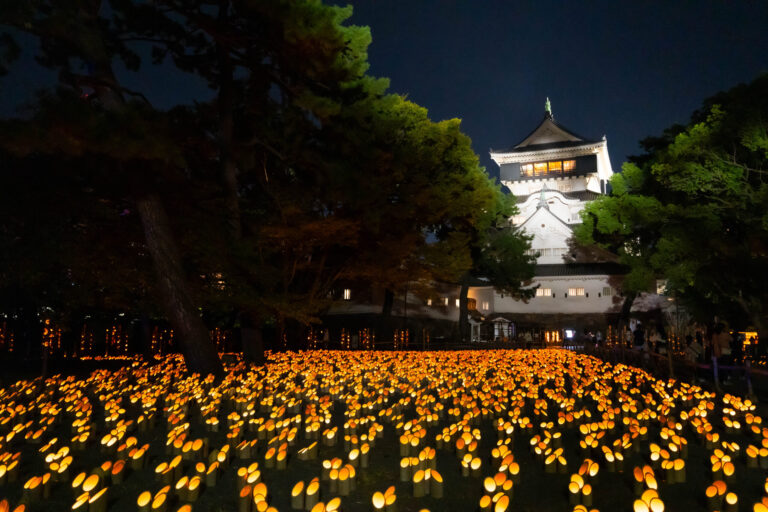




Wasshoi Hyakuman Natsu Matsuri is held on 19 and 20 September 2026 in central Kitakyushu, and draws more than 1.5 million people across the two days. Note the dates. It is called a summer festival, and until recently it was one, but the organisers moved it out of early August because the heat had become a health risk. The first September edition ran in 2025; the number of people treated at first-aid stations fell from seven the previous year to one. The committee voted in May 2026 to keep the new dates.
SEVEN TRADITIONS, ONE STREET
Kitakyushu was created in 1963 by merging five industrial cities, each with its own festivals, and the city as a whole did not have one. The festival was invented in 1988 to fix that, for the 25th anniversary of the merger. It was planned as a one-off; the response was large enough that it has run every year since. 2026 is the 39th edition.
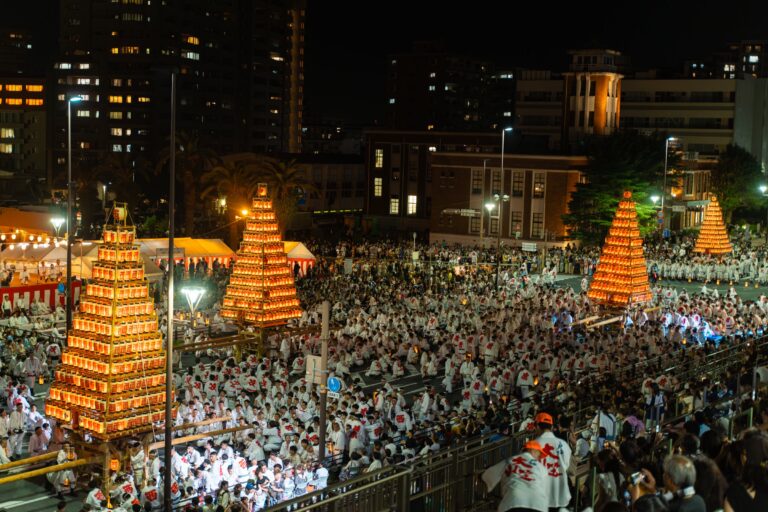
That origin explains the programme’s centrepiece. Natsu Matsuri Daishugo – roughly, “the summer festivals, all together” – brings the float traditions of the old five cities onto Komonji-dori for three hours on the Saturday evening. In 2026 that means the Dairi illuminated float, the Kokura Gion drums, the Nagahama Kifune Shrine portable shrine, the Wakamatsu Goheita-bayashi, the Yahatahigashi nebuta, the Kurosaki Gion float and the Tobata Gion Ohyamagasa – with a guest appearance by the Anou first-district float. Which specific floats appear changes from year to year.
Two of these are worth knowing about in advance. Tobata Gion Ohyamagasa is inscribed on the UNESCO Representative List of the Intangible Cultural Heritage of Humanity; its floats change form between day and night, from banner-topped daytime floats to pyramids of stacked lanterns. Kurosaki Gion is known locally as the kenka-yama, the “fighting float”, for the way its floats are driven at each other. Seeing them side by side in one place is not otherwise possible – in their home districts they run on different dates, in different wards, sometimes months apart.
THE SECOND DAY
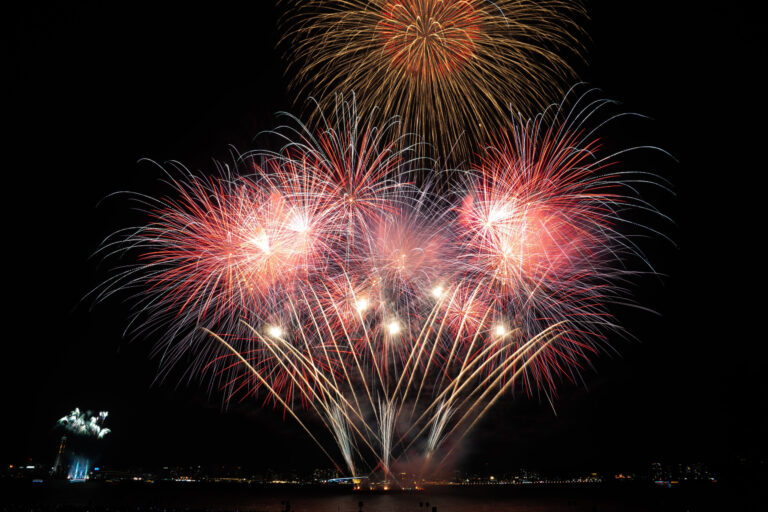
Sunday is the participation day. Hyakuman Odori, the “million dance”, puts more than 3,000 dancers on Komonji-dori across two sessions from 16:00, and from 2026 you can join on the day rather than only by advance application – a change worth knowing if you are a visitor who wants to do more than watch. Before that, a yosakoi competition runs across three separate stages from late morning, and a parade of more than thirty companies and community groups fills the early afternoon. The evening closes with a ten-minute fireworks display at Katsuyama Park at 20:20.
Be clear about the scale of that last item: ten minutes, as a finale. If fireworks are what you are travelling for, the Kanmon Strait display on 13 August is the one to plan around, not this.
EATING, AND THE REST OF THE GROUND
Both days carry a food and drink programme on the great lawn at Katsuyama Park from midday to 21:00, built around Kitakyushu’s own dishes and local producers rather than generic festival stalls, alongside a separate children’s area on the south side. This matters more than it sounds: the evening programmes on Komonji-dori do not begin until late afternoon, so the park is where the day actually starts, and it is the part of the festival where you can sit down.
The 2026 theme is “Walk Together!! Kitakyushu Pride!!”, with the subtitle “everyone is a Kitakyushu ambassador” – which is a fair description of how the event is run. It is organised by a promotion association of roughly 300 people drawn from the chamber of commerce, the junior chamber, the city, the tourism and convention association, neighbourhood associations, women’s associations, companies and community groups. There is no single shrine or family behind it.
- Dates: 19 (Sat) – 20 (Sun) September 2026, 39th edition. Moved from August because of extreme heat
- Venues: Komonji-dori, Katsuyama Park, around Kokura Castle, Otemon Plaza, Riverwalk Kitakyushu
- Saturday: Children’s float parade 16:30; opening ceremony 17:00; Natsu Matsuri Daishugo 17:15-20:00; music stage 20:00-21:00
- Sunday: Yosakoi 11:00-17:30; parade 14:00-15:00; Hyakuman Odori 16:00-19:00; fireworks 20:20-20:30
- Attendance: More than 1.5 million across the two days in a typical year; about 15,000 take part
- Joining in: Hyakuman Odori accepts same-day participants from 2026. Individual advance applications close 13 September
- Paid seating: Supporter seating in front of City Hall. Advance sale via Ticket Pia, 1 August – 14 September. 3,000 yen (19th) / 2,000 yen (20th). First come, first served
- Food: Food and drink on the Katsuyama Park lawn, 12:00-21:00 both days. Children’s area on the south side
- Theme: Walk Together!! Kitakyushu Pride!!
- Access: Kokura Station – a Sanyo Shinkansen stop, about 20 min from Hakata – then a short walk
- Official Info: wasshoi.info
WHY IT IS WORTH THE TRIP
Most Japanese festivals a foreign visitor is likely to see are old, single-tradition and rooted in one shrine. This one is none of those things: it is 38 years old, it was designed by committee, and its purpose was to make a merged industrial city feel like one place. That is an unusual thing to watch, and it is also unusually easy to join – the dancing is open, the crowd is local rather than touristic, and the organisers are actively trying to bring people in.
It is also, practically, a good weekend to be in Kitakyushu. Kokura Station is a shinkansen stop 20 minutes from Hakata and 15 from Shin-Shimonoseki, the festival sites are all within walking distance of it, and Kokura Castle and the Mojiko Retro harbour district are close enough to fill the daytime hours before each evening’s programme begins.
And the move to September is itself an argument for going. Early August in northern Kyushu is genuinely punishing – the reason the organisers shifted the dates in the first place – while the third weekend of September is usually warm rather than dangerous. For visitors from Europe, North America or Australia planning a western Japan route, that is a more comfortable window than the peak of the Japanese summer, and it falls outside the domestic Obon travel crush in mid-August, when trains and hotels across the region are at their most difficult to book.
Sources: Wasshoi Hyakuman Natsu Matsuri Promotion Association, Kitakyushu City #WestGoldenRoute #Kitakyushu #Festival #Nukumori