


Text and Photos by Jeremy Hannigan, August 2026
The late afternoon sun weighs down, hot and heavy. Milky, sunscreen-infused beads of sweat run down my face and arms as I search the sand for critters. Upon careful inspection, here and there, I see what looks like tiny little tire treads occasionally crossing the space between the countless misshapen footprints that pepper the dunes. Tracks.
One of the displays in the second-floor museum of the nearby visitor center showcases the various insects that call the dunes home; beetles, grasshoppers, wasps and apparently even wolf spiders. I intend to find at least one of them. Preferably not the latter two.
As luck would have it, my companion for the trip, Haruka, happens to spot something—a yamatomadarabatta or “Japanese spotted grasshopper.” Being brown, beige and, well, spotted, its camouflage makes it difficult to track as it jumps. I get just one too-far-away photo before it hops out of view. Of course. Can’t find it, can’t shoot it, and can’t even pronounce the damned thing’s name. Ya – ma – to – ma – da – ra – ba – tta. You try it.
Where are we, though?
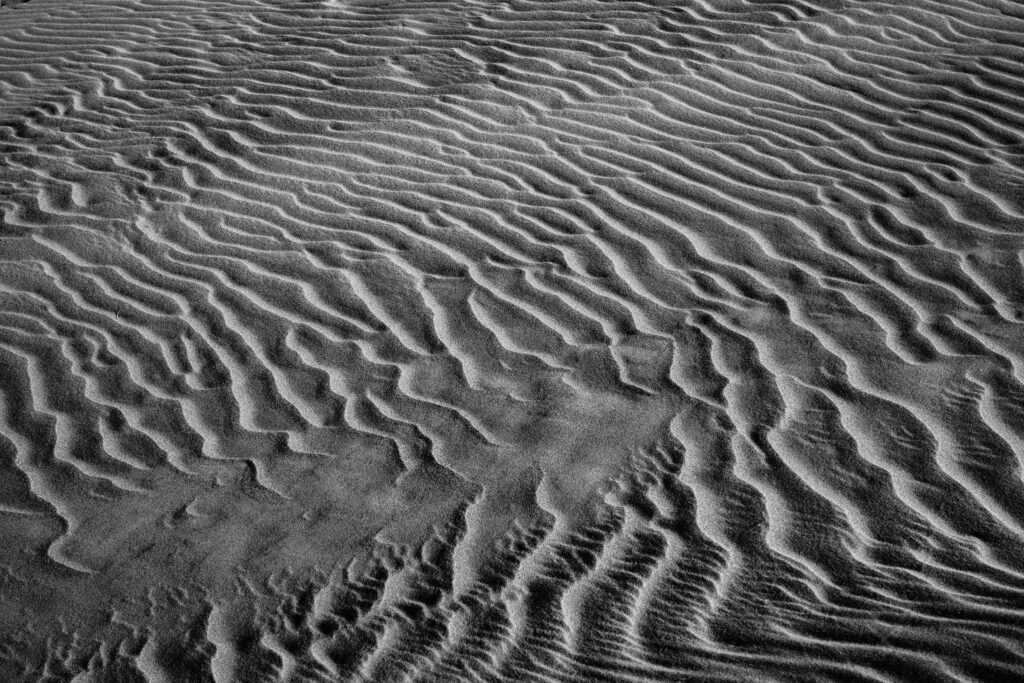
The Tottori Sand Dunes, known as Tottori Sakyu in Japanese, are known for being significant. Really, the dunes are all a lot of people even know about the prefecture. And compared to other similar geological landforms in Japan, they really are significant. Stretching across the coastline of the Sea of Japan for well over a dozen kilometers, as well as inland by roughly two kilometers, the dunes paint a picture of Japan not typically conjured up in minds or media. The fine, yellow sand combed by the wind into winding, textured ridges, looks more like a scene out of Lawrence of Arabia—minus the firearms and mirages. (There are camels, though.) That is, until you reach the tallest, sandy precipice and suddenly find yourself gazing at the brilliantly blue, roaring ocean; a breathtaking view if there ever was one.
But my short journey through Tottori didn’t start here. It began with ocean spray—if we’re excluding the long train ride from Tokyo, anyways.

The car cruises down the highway, dense greenery soaring past on either side. We arrived in Tottori Prefecture around half an hour ago, but still have a ways to go before reaching the coast of the Sea of Japan. Our first destination, the seaside town of Iwami, lies just northeast of the capital, and boasts some very striking coastlines. The local business San'in Matsushima Yuran helps visitors to properly appreciate said coast, so that’s where we’re headed first.
I’m glad to be crossing Tottori off of my list. If I recall correctly, it’s my twenty-sixth prefecture, but only my third visit to the side of Honshu that faces the Sea of Japan. Tottori belongs to Honshu’s westernmost region, Chugoku, and has been the nation’s least populous prefecture since modern census records began. As such, public transportation, though reliable, is sparse, and the prefecture is one of eight on the main island that is without direct bullet train access.
Living in a big city like Tokyo, you grow so accustomed to convenience that it ends up being taken for granted as a simple fact of life. Missed the bus? Don’t worry, there’ll be another in ten or fifteen minutes. Itching for a snack or easy meal? The nearest convenience store is only a five minute walk away. Need that snack in the middle of the night? No problem, that convenience store is open ‘round the clock. Have to send a package to some place? There’s the post office, several couriers and the aforementioned convenience store, plus a dozen more, so take your pick.
A place like Tottori challenges that. The bus bound for the Uradome Coast, the 33 Iwami Iwai Line, comes every hour and twenty minutes. You miss that and you’re looking at an arguably comfier train ride, but then a much, much longer walk. Timing is everything.
Luckily, by car, Haruka and I are there in about twenty minutes.
On our left, the ocean stretches into the horizon. On our right, properties drift past. In many parts of Japan, there’s an ever present sense of history. It’s often in the form of old buildings, old customs and possibly even older people. In a weird way, it’s also sometimes felt in newer builds; at least, there’s a sense that something was there, but has been inevitably replaced. This corner of Tottori holds its fair share of old structures erected generations before me, as well as obviously new and attractive builds that conjure up feelings of envy. Iina.
Upon arrival, we have only a short time to get our bearings before we set sail. San'in Matsushima Yuran’s “Uradome Coast Island Cruise” offers hourly boat tours via three different types of vessels. Choosing the “small boat” that seats just a dozen people allows for greater maneuverability throughout the rocky, tunnelled inlet, and I soon find myself seated in the spot closest to the bow, life preserver wrapped around my waist, camera at the ready.
When travelling in Japan on a clear day, sunscreen is just as much a necessity as water. The weather app says it feels like 37 degrees Celsius, but I’d round it up to 40, and the bright sunlight shimmers and reflects off the blue, turquoise and very translucent water. I’m very glad the boat has a roof.
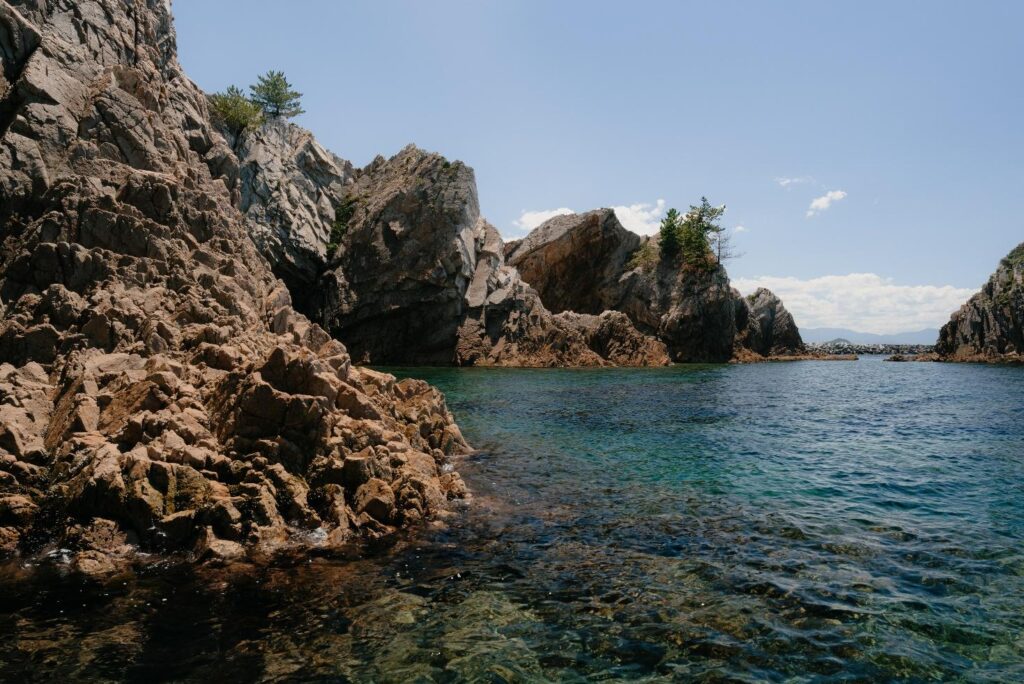
For the most part, the pace is pretty relaxed, but here and there, we speed up a fair bit, leading to more noticeable bouncing and splashing. I don’t recall ever struggling with sea sickness, but then I also can’t recall the last time I was on a boat that wasn’t a ferry. Do I feel a bit off? Am I likely to hurl? The moment of paranoia brings with it a faint nausea. But no, I decide. I don’t get sea sick. Never have. And I realize the nausea is just plain ol’ hunger. Crisis averted. Back to the task at hand.
I have two goals; first, take at least a few adequate photos to go with this writeup, and second, protect my camera and lens from getting wet at all costs.
Writing from the future, I feel like I succeeded more with the second than the first here. Photos don’t really do the tour justice. You can’t see how crystal clear the water is. You can’t smell the salt. You can’t experience the rocking and swaying of the boat. You can’t feel the caverns’ rocky walls narrowing overhead and weighing down on you. And you certainly can’t feel the saltwater spray mingle with your sunscreen and sweat, forming a greasy film that covers every bit of exposed skin and, unfortunately, your sunglasses.
The guide (and captain, I guess?) steers the boat from the back and speaks into a headset linked to some speakers in the boat. I assume he’s describing the history and geology around us, but even if my Japanese were better, I don’t know if I’d be able to pick out much over the sounds of the waves and the boat’s motor. The other guests seem plenty pleased with his explanation, though.
After completing the cruise and returning to shore, Haruka and I make our way to the restaurant operated by the tour company, Minato Cafe. Their lunch menu proudly advertises burgers, but upon closer inspection, there isn’t actually anything available that one could accurately call a burger. It’s all fried fish sandwiches, and that sounds just as good to me.

I order the hotaru-ika baga setto, which I’d translate to “firefly squid sandwich combo,” then have a look around.
The decor is kitschy—in a good way. I see a lifebuoy, several model tall ships, ornamental anchors and a lot of lighthouses of various sizes. Like, a lot. There’s also a sign adorned with an Old English typeface proudly exclaiming “The rougher the seas, the smoother we sail!” I get a flashback of a restaurant my family frequented when I was still in elementary school—Mug and Musket—though I don’t see any cannons, pistols or muskets here. Oh well.

Lunch is tasty. The hotaru-ika baga’s bun is appropriately jet black and inside, the squid cutlet possesses a perfectly crispy exterior and juicy interior. The fries are few in number, but that’s to be expected at just about any place in Japan. All in all, no complaints.
Up next is the Sand Museum and after another ten or so minutes in the car, we’re there. Having opened in 2012, it feels quite modern, sporting a spartan concrete entrance and an exterior that’s primarily glass. It’s also easily the busiest place we visit during the two-day trip, along with the nearby dunes.
When I think of museums, I think of science and history. The Sand Museum is more of a contemporary art gallery, masterminded by sculptor and executive producer Katsuhiko Chaen, and made possible by Tottori City in an effort to capitalize on its most prominent tourist attraction. Since opening, sand sculptors from around the globe have been invited to participate in the museum’s annual exhibitions, crafting massive and intricate objects and scenes out of nothing but sand and water—no glue or other trickery. Because of this, the same sand is able to be reused year after year.
Being sculpted from pure sand, the art pieces naturally degrade over time, even in a controlled environment. Their impermanence is thus part of their beauty, and part of what makes the viewing experience a relatively unique one. Every year, a new cultural theme based on a different country or history is chosen, which the entire exhibit is then built around. Several artists from various nations then spend just two weeks crafting each piece, with the results of their efforts being a truly international collaboration. Themes from previous years have included the Italian Renaissance, Africa, Russia, and ancient Egypt, the last of which I’d have very much liked to have seen.

This year’s theme is Spain, primarily in honour of Antoni Gaudi, who passed away a century ago.
Entering the almost-2,000-square-meter central exhibition floor, I’m stunned by a very tall and elaborate Sagrada Familia, from which various religious figures emerge, one adorned with a crown, one a harp, another a fiddle, and all clad in beautifully flowing robes. I’ve always loved the visual arts and have spent much of my life drawing. Sculpting has never been my forte, though. Constructing three-dimensional pieces out of clay is tough enough. How the hell was this created out of sand?!
There’s a lot to take in, with each of the nineteen sculptures being astonishingly detailed in its own way. Some depict architecture, some landscapes, others portraits, and some even full scenes complete with multiple figures. Among them, I find Don Quixote, the fall of Granada, Islamic scripture, depictions of war and invasion, Christopher Columbus and, of course, bullfighting.
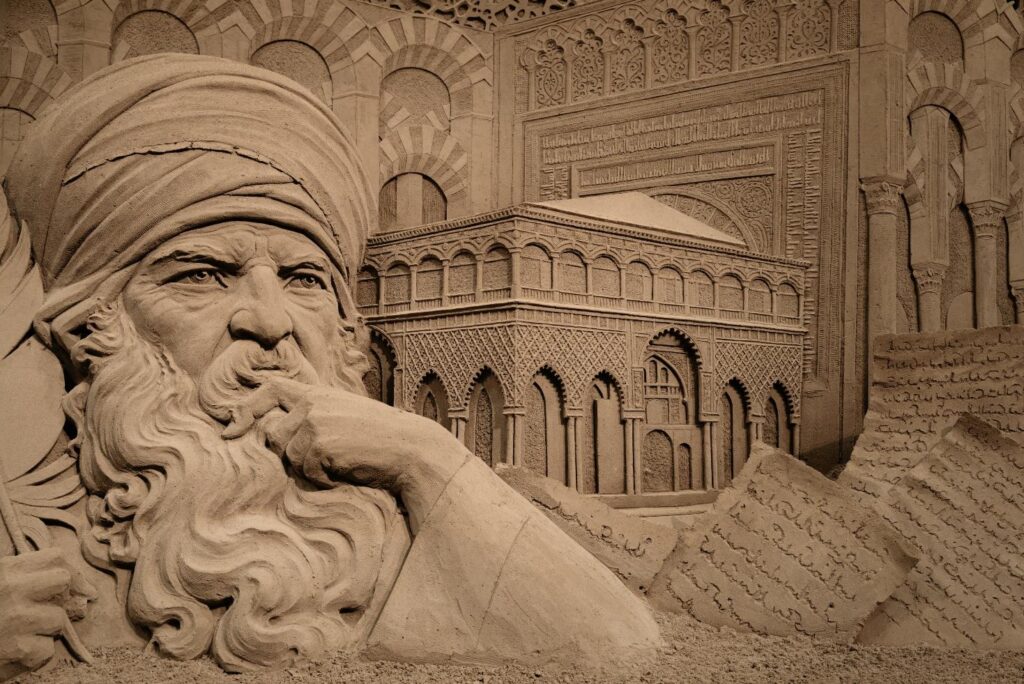
Oh, there’s also a kaiju-sized soccer player kicking a titanic ball through an historic cityscape. “Who do you think would win, this guy or Godzilla?” I ask Haruka. I get only a quizzical look in response. Whatever.
It’s time to head on over to Tottori’s famed dunes.
We park and then enter the Tottori Sand Dunes Visitor Center. Inside, we meet Tsuruta-san, who kindly takes us up to the second floor museum area for a tour. A native of Tottori, Tsuruta-san seems to have a gentle passion for the local history; a sort of humble pride, maybe. She talks us through the “Geo Zone,” which details the formation and topography of the terrain, then the “Creatures Zone,” (where I perk up just a little bit,) which contains a display about the various insects that call the dunes home, each represented by a frighteningly large and lifelike model. I resolve to seek a few of these critters out once we head back outside.
Next comes the “Life Zone,” a display detailing the history and relationship people have with the dunes, spanning agriculture, development and more recently, preservation. There’s a lot of talk of preservation in developed countries these days; save the historical buildings, save the rainforests, save the local culture, save the critters and save the climate. A lot of it is likely too little and too late. Tottori, on the other hand, has been at it since the fifties, with the dunes being designated a National Natural Monument in 1955, then incorporated into the San’in Kaigan National Park in 1963, which meant even more protection. They began to shrink rapidly following the second world war and today, they occupy roughly thirty square kilometers—about twelve per cent of their original size. Still, they remain because of the efforts of people who saw their value.
Back outside, we head northwest into the dunes. It’s hard to walk on such fine, deep sand. Shoes just sink into it. The late afternoon sunlight is blinding. It’s five p.m., but it still feels like high noon. I want to explore. I want to find the best angle from which to capture this glorious geological phenomenon. But lord, am I tired. I’ve been awake since five a.m., so that’s… twelve hours now. At least I’m still able to do basic arithmetic.

My sunglasses and CPL filter are still cloudy and grimy from the salt of the ocean spray. This, coupled with the harsh light and lack of lens hood makes photography just a bit tricky. That’s my excuse, anyway. There are also plenty of people in view. It’s a Thursday afternoon, albeit during the summer break for students, and like the Sand Museum, a couple dozen people can be seen here and there, dotting the horizon. All over, the dune’s natural texture has been transformed by countless footprints. I can’t imagine what a weekend is like; an exodus moving through the sand, waiting for the Sea of Japan to be parted? I am tired.
It must be hard, balancing ecological preservation while striving to boost and maintain the local economy through tourism.
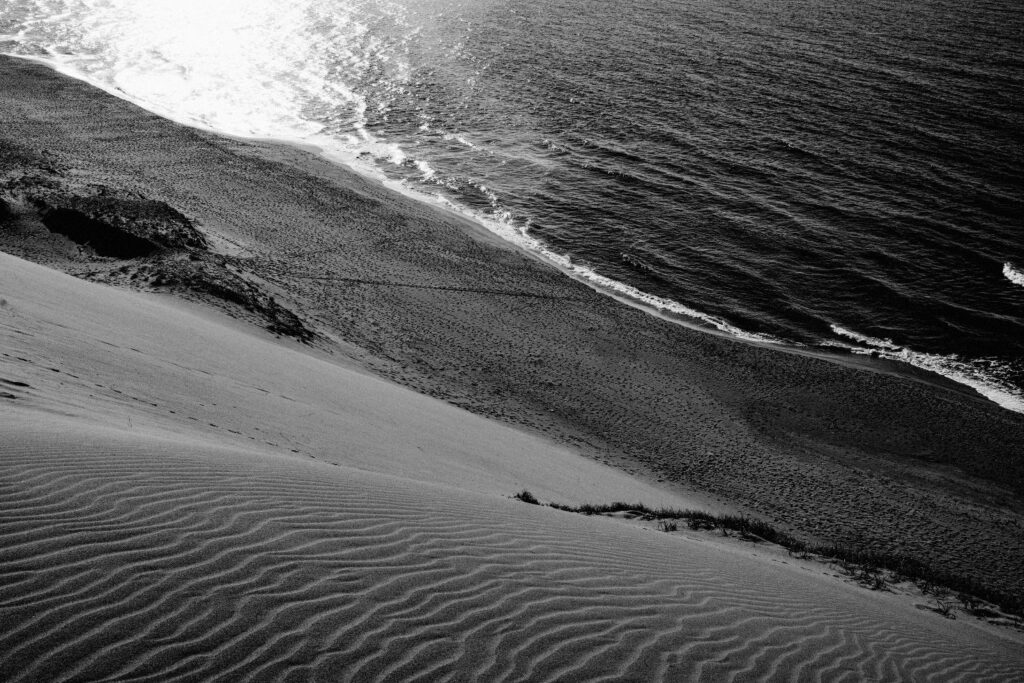
Haruka and I make our way up a sandy hill, and upon reaching the summit, look down to see a beach of much darker sand and the ocean. Though footprints have decimated the crest of this dune, the steep decline towards the ocean is untouched, its surface perfectly combed by the wind into fine ridges. We remain unmoving for several minutes, simply watching the scene.
A short while later, back at the car, I remove my footwear, turning it upside down. A comical amount of sand pours out. My damp socks have taken on a texture like sandpaper. Great. Well, onto the next destination.
People who aren’t from there generally travel to the sticks to discover local flavour. I find some of that back at the Uradome coast in the form of a little, frozen-in-time neighbourhood called Ajiro. I love it. Equal parts quaint and eerie, it’s a remnant of the Showa era and for a fan of Japanese horror like myself, (Silent Hill, Siren, Ito Junji, etc,) it’s very cool. But being in a car and on a schedule, I don’t get to properly take it in. Not so cool.
For whatever reason, Japanese people tend to conflate the English words “local” and “countryside,” the latter of which is usually used as an adjective meaning “rural.” I’ve never been able to figure out how the two became synonymous, but this little street certainly fits the description.
The road is very, very narrow. I pray we don’t encounter oncoming traffic. How do we get to the Sengan Matsushima observation deck anyways? It doesn’t look like there’s a through-road. In fact, according to Google Maps, this is a dead-end. And yet… Haruka finds a place to turn and begin climbing into the mountain. I don’t see this road on the map. We must’ve gotten turned around or something. (Author’s note: I later found out after returning home and carefully reviewing my photos and videos that GPS was being wonky and showing the wrong road.)
A larger building comes into view on our left. It’s a patchwork of wood, metal, ivy, and rust. Behind it, dense foliage swallows the last of the daylight. OK, I am a fan of horror, but this is a little too real.
“What the hell is that,” I mutter.
“I think… elementary school?” Haruka replies.
“A haunted elementary school?”
“Looks like a school, right?”
“Um, from a Canadian point of view, no.”
At least it’s a landmark. I search for a school in the app and there are zero results in this area. Spooky. Beyond, it’s all asphalt and trees. Fine. We’ll turn back, park and hike the distance to the Sengan Matsushima observation deck. We should still have some time until the sun sets and I’m already sweaty, anyways. Given the hike planned for tomorrow morning, I’ll probably come to regret this unplanned leg-focused exertion, but what else can we do?
Back at the seaside, the steps that lead up from the small parking area are soon swallowed by a dark tunnel of trees and shrubbery. I’m so glad I brought insect repellent. The winding path climbs steadily up and I maintain a brisk pace, keeping my eyes straight ahead, trying to ignore the dense spiderwebs peppered here and there that I see out of my peripherals.
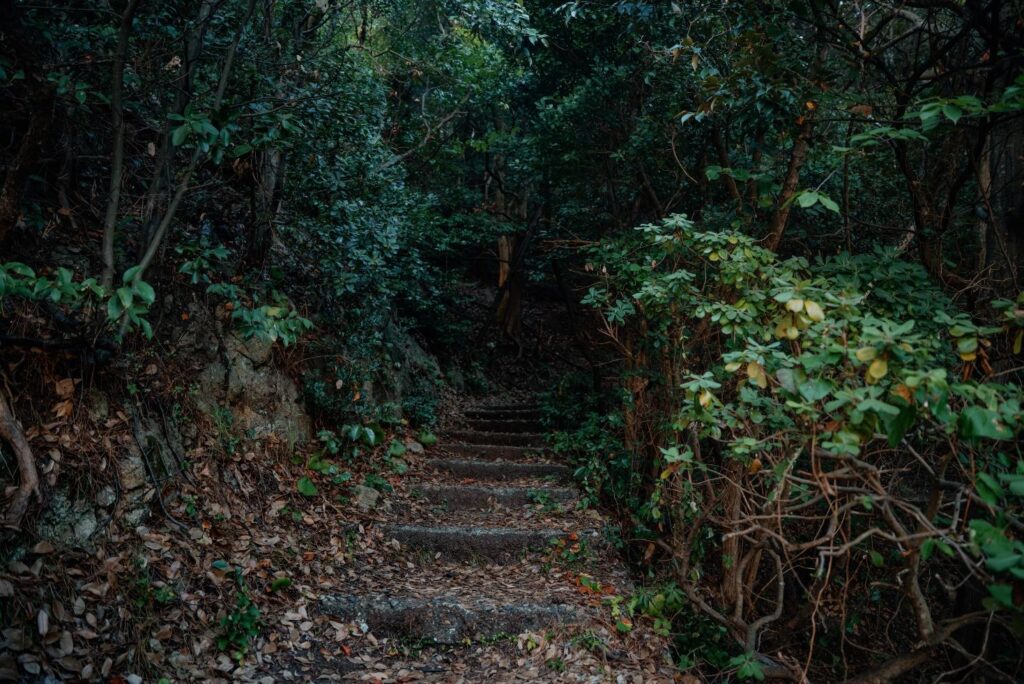
But for my own ragged breathing, it’s quiet. Sort of. Sure, there’s the symphony of cicadas and the constant sound of the ocean, but these fade into background noise; they’re part of the scenery, like the pebbles, roots and fallen leaves. It feels like the route is largely left alone, rarely hiked and rarely maintained, if at all.
In the big city and its surrounding neighbourhoods, there’s little quiet and little solitude. Adventure is hard to come by. Virtually nothing left to explore, nowhere to get lost. Us city folk are sheltered. Liability leads to restrictions in the form of fences, cones, handwritten signs of paper, printed signs of plastic, notices and a very tame and, let’s say, “curated” experience.
By comparison, Tottori feels real.
We emerge from the trees and are greeted by a great view. Forgive the cliché, but my god, what a view. The last moments of the day’s sunlight wash the scene in a warm, brilliant orange. The trail descends to an observation point behind some seemingly very abandoned houses, before snaking back up into the greenery of an adjacent hill.
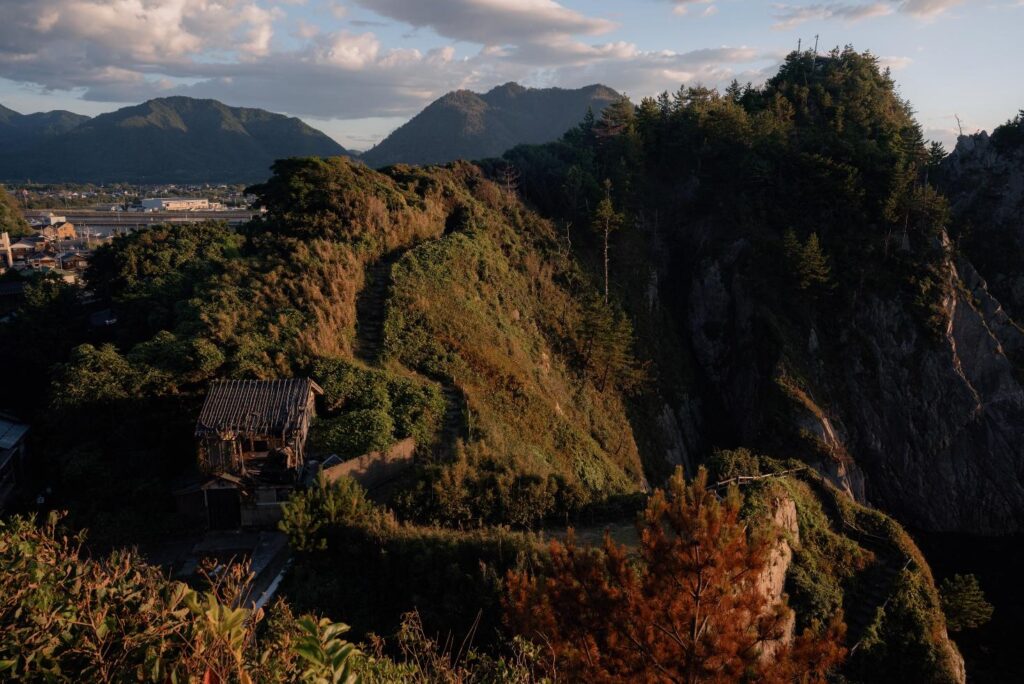
I already want to return. I need more time here. I have to walk the full length of this trail—slowly. I have to see every view from every observation point. I have to inspect these abandoned houses—from a respectful and legal distance, of course. And I have to walk the Ajiro neighbourhood below. Why did I suggest a mere three-day trip? Shouldn’t I have known I’d want to take my time?
Well, I guess this just means I’m going to have to find some way to come back. Hopefully in a different season, however. I can’t deny it—the summer weather is a bit of a drawback. I soaked through two tops in one day and I know my shorts probably hold an odour that I’m not brave enough to face, especially knowing that I’ll have to put them on for another two days. But this landscape and this sunset are worth it. Tottori is worth it.
The last sliver of sunlight sinks into the horizon and Haruka and I head back to the car. It’s time to rest. A daunting task awaits in the morning.
