


Text and Photos by Jeremy Hannigan, August 2026
The mountain is alive with sound: a cacophony of buzzing and creaking from countless cicadas, a sonic celebration of summer. Despite this, the atmosphere of Mitoku-zan is one of quiet solitude and reverence.
This is what I’ve been most looking forward to; Sanbutsu-ji and its climb to the national treasure Nageiredo.
The temple opened a mere five minutes prior to our arrival and but for the chorus of cicadas and occasional birdsong, all is quiet, the parking lot close to empty. The bus ride from Kurayoshi takes just under fifty minutes, with the earliest departure being a quarter to eight, so I’m once again grateful to be travelling by car with Haruka.
An unassuming staircase of stone stretches diagonally from the pavement into the green mountainside, leading us up to the reception office at the entrance of the facility. My eyes dart about, greedily drinking in the surroundings. I want to explore and photograph everything. But first, a visit to Rinko-in, one of the “sub” temples contained within the greater temple complex, to have a chat with Yoneda Ryojun.

The image I typically conjure up of a Buddhist monk is one of unwavering seriousness and ascetic sobriety. With his kind eyes and animated speech, Yoneda-san, Sanbutsu-ji’s deputy chief steward, seems just as much a passionate educator as holy man (if a Buddhist can even be referred to as such). His enthusiasm for the temple, mountain and its history is apparent, though I only understand bits and pieces of what he says without interpretation.
Yoneda-san first explains that the name Sanbutsu-ji refers not to any single edifice, but rather to the broader temple structures and monuments scattered across the mountain. Said to have been founded in 706 AD by the founder of Shugendo—an old syncretic religion comprising Shinto, shamanism and esoteric Buddhism—the site initially enshrined three deities, though the temple’s history up to the late Heian period is not entirely clear, and today, the temple formally belongs to the Tendai sect of Buddhism.
The hall where we meet Yoneda-san, Rinko-in, and the neighbouring buildings, including the main hall, are a place for ordinary worship. Beyond these, however, lie the kekkai-mon, or “boundary gate” and a small bridge, Shikuiribashi. He stresses that those who proceed beyond this point are no longer ordinary visitors. This gate marks the boundary between two worlds and those who take this path become ascetic practitioners, symbolically passing into another realm for spiritual training, and then returning to this mortal plane reborn.
Some may find this explanation too poetic or even pretentious. “It’s just a hike,” you might say. As an analytical agnostic and avid left-brain user, it would be dishonest of me to say that I truly believe in the spiritual power of any such place. But there’s no denying the historical and cultural power. For over a millennia, this route has been a pilgrimage, with each of the seven halls and landmarks along its perilous ascent carrying a symbolic role within a larger spiritual narrative, all culminating in Nageiredo.
Somehow built into the cliffside of Mitoku-zan during the Heian period and remaining there until today, (seriously, this structure has never been rebuilt,) Nageiredo has withstood the nation’s innumerable earthquakes for almost a thousand years. Indeed, some two hundred meters above the base of the mountain trail, Nageiredo seems almost to defy gravity itself and the route there is not an easy one. As a matter of fact, it’s been dubbed Japan’s most dangerous national treasure and accordingly, has apparently seen its share of fatal incidents over the years—though I couldn’t actually find any specific information about these mishaps.
As such, there’s some mild trepidation on my part.
I was warned a few days earlier via email that visitors could be refused entry if their footwear didn’t meet the temple’s safety requirements. I chalked that up to the standard conscientiousness and cautiousness typically exercised all over the country. Japan is very much a nation of endless rules and signage, with all manner of memos, notifications and warnings displayed virtually everywhere, even in the most ancient and sacred of religious sites.
This time, however, that’s not the case.
There are plenty of signs and notices strewn about, sure, but the cautiousness with which the hike is treated is not mere fretfulness. To put it simply, the hike is tough. And that’s no accident.
In Japan’s ancient Shinto religion, the natural world as we know it is sacred, with all things, such as rocks, trees and rivers, being home to divine spirits. Basically, nature = god(s). Similarly, Yoneda-san explains that Shugendo is the practice of entering nature, experiencing it with all of one’s senses and then nurturing what has been learned through the ordeal. He emphasizes that the hike up Mitoku-zan is not an act of conquest, but one of humility, purification and rebirth. It’s meant to teach you about nature and about yourself. During the route to and from Nageiredo, pilgrims undergo hardship and return to their lives stronger and wiser.
Well, it’s a sweltering 30 degrees and for that reason alone, hardship is pretty much guaranteed.


After escorting us to the gate marking the beginning of the trail, Yoneda-san presents us with white wagesa, a traditional religious sash worn by all during their ascent. On the sash is written four kanji, rokkonshoujou, translating to something like “purification of the six senses,” these six senses being the eyes, ears, nose, tongue, body and mind.
While I loop the wagesa around my neck, Haruka’s footwear is inspected and deemed unsuitable for the journey. As a result, she’s required to put on waraji, traditional sandals of woven straw—and what looks to my eyes like white rope made of polypropylene twine. Old meets new. To be perfectly honest, I have doubts about the safety of said footwear—at least over the relatively flat-soled sneakers Haruka initially had on—particularly in regards to her now exposed skin and toes. At this moment, I’m very glad to have worn appropriate hiking boots because I know that there’s no way I’d be able to complete the journey in waraji—especially with my sized thirty-one feet.
Finally, after purchasing a bottle of water for the journey, we pass through the kekkai-mon… …and into another world.
The sun’s brilliant rays pass through the dense greenery overhead, casting staccato shadows over the soil, stone and foliage. I’m grateful for the shade as I think the majority of my sunscreen has already melted away with the incessant sweat. I wish I were joking.
Surprisingly, shortly after passing over the Shikuiribashi bridge, the trail seems to disappear into the mountainside. In front of me lies a dense collage of winding tree roots snaking in and out of the soil. Just above, I see the trail continue, so I grab hold of the thick, sturdy roots and climb, wagesa bouncing against my chest.

I sometimes worry that I document more than truly experiencing—if that makes any sense. When my eyes aren’t hidden behind the camera’s viewfinder, they’re glued to its LCD screen. I am a cyborg, the camera a mechanical and electronic extension of my being. I’m exaggerating some, (I’d actually bet I’m more spatially aware than most,) but the fact remains that capturing something via camera is often on my mind. For much of the hike up Mitoku-zan, however, that’s not the case.
Both hands are required to make the ascent and for the first third of the journey, my cameras remain in my backpack. And that bulging backpack, housing two bodies and four lenses, probably adds at least an extra five kilograms to my person. It doesn’t sound like that much, but the hike seems to be getting more vertical. Every time the trail levels out, I breathe a sigh of relief, but after a few short meters, it suddenly once again disappears into a rocky hill or patchwork of gnarled tree roots. Being a largely sedentary ojisan, I need to stop for a breather earlier than I’d care to admit.
Several breathers, actually. And a mouthful of water with every one.
Finally, after some twenty or thirty minutes of scrambling over and up all manner of terrain, the canopy of foliage thins out and the sky opens up. Above, the first of the pilgrimage’s four halls, Monju-do, is visible… …precariously perched over a steep rocky face littered with boulders, upon which a network of arguably spindly wooden beams rest, somehow supporting the structure.
I eagerly scramble up the winding stone path, thrilled to see a landmark and place at which to properly rest, when suddenly, I come upon a dead end. The dirt pathway narrows and then disappears into a slender crack formed by several very large boulders. Eyes darting left and right, up and down, I search for a way to proceed. Nothing. All of a sudden, I become acutely aware of how brutally my thighs ache, how blistered my soles feel and how ragged my breathing is. Perhaps I missed something and left the trail? I turn around, posterior sliding against the rough stone surface, and see the laminated “worship route” sign bolted into the rock, stark blue arrow pointing directly into the crack of the boulders. How? Just how?
“I actually don’t know,” I say aloud to myself, far too exhausted to figure it out.
Haruka emerges from the darkness of the foliage below, clambering up towards me, then stopping. “I’ve got to head back and sit,” I gasp at her. “My legs are givin’ out here.”
For a novice, climbing mountains sometimes feels just as insurmountable as moving them. Just a dozen meters under Monju-do and I actually think I’m going to have to throw in the towel. How is it that I have so little water left? Only a couple of mouthfuls? I’ve tried to channel my inner survivor and ration it. Haven’t I? God, the heat. And my poor, aching, absurdly slender thighs.
Not exactly the best state to learn how to be mindful.
Haruka and I maneuver around each other, her moving up and me, down. I look above and see her stretch out her leg to gain footing on one of the boulders. “Please don’t fall,” I think. “I don’t know if I have the energy to catch you.” But she doesn’t fall. She manages to get herself over the crevice and the massive boulder above. So that’s it; the way forward. Perseverance. And familiarity with cardio.
A few minutes later and I’m back at it. Haruka chuckles as I make it over the boulder and turn around, placing my hands on my knees, my breathing heavy as ever. The view is already stunning, but we still have more climbing to do. I resolve to make it to the wooden structure just above us, but feel very skeptical about going beyond that.
“I don’t think I can go to the end,” I gasp, “I’m just too out-of-shape for this.”
Don’t lose heart. Trust me when I say the first part of this hike is definitely the hardest. And we aren’t out of the woods quite yet. The trail continues between the wooden pillars supporting Monju-do and the dense greenery carpeting the side of the mountain. A chain is wrapped around one of the pillars and leads up, inviting pilgrims to grab hold and give their arms a workout for a change. Happy to. And after the quick climb, we finally reach Monju-do.
More than just a landmark and vantage point, the Monju-do temple is associated with wisdom, with practitioners said to receive such at this point in the route—though I can’t say with any certainty that I’ve obtained said wisdom. We take off our shoes to walk on the wooden balcony encircling the structure and see a rich blanket of greenery stretching into the distance under the vivid blue sky, gorgeous and intimidating. (I may also be afraid of heights…)

While we enjoy the view and the rest, we’re met by two more practitioners. A Japanese couple, maybe in their fifties, have kind of kept pace with us for most of the hike. We’ve made quicker time, but thanks to my breathers and the occasional photo, they’ve caught up here and there. Seeing that we’re out of water, the woman offers a small unopened carton of Savas protein milk—caramel flavour! I wish I could remember their introductions and the few words we exchange, but the hike drains my memory as well as my energy. But they’re kind strangers; I know that much.
Fifteen minutes later, we continue on, my resolve once again strengthened. (Haruka’s totally fine, by the way. The drama is mine and mine alone.)
After crawling down over some more boulders on the other side of Monju-do, descending once again into the trees, and then using another stretch of chain to traverse a very narrow path above a steep drop, we find ourselves at the base of Jizo-do, a structure much like the former, though representative of life and protection rather than wisdom. Shortly after that, we come across a smaller, open edifice, Shoro-do, whose massive, two-tonne bronze bell I ring before crawling under to continue along the path.
A short ways later, I come upon Nokyo-do and further along the path, Kannon-do, wreathed by the greenery and looking especially picturesque. Whereas Monju-do and Jizo-do face the expansive sky and valley, the majority of Kannon-do is swallowed by a dark cave, its exposed side facing the dense flora surrounding the path. The trail winds into the cave behind the temple, with visitors meant to pass behind in utter blackness. This ritual is referred to as tainai-kuguri, literally “passing through the womb,” with one’s emergence symbolizing being born again as a renewed person with a new beginning. It’s honestly quite surprising just how dense the darkness is on such a sunny day. I can’t help but worry about some large centipede or huntsman spider finding its way onto my backpack or hat during the short walk, but thankfully, I emerge born again, without any additional company.
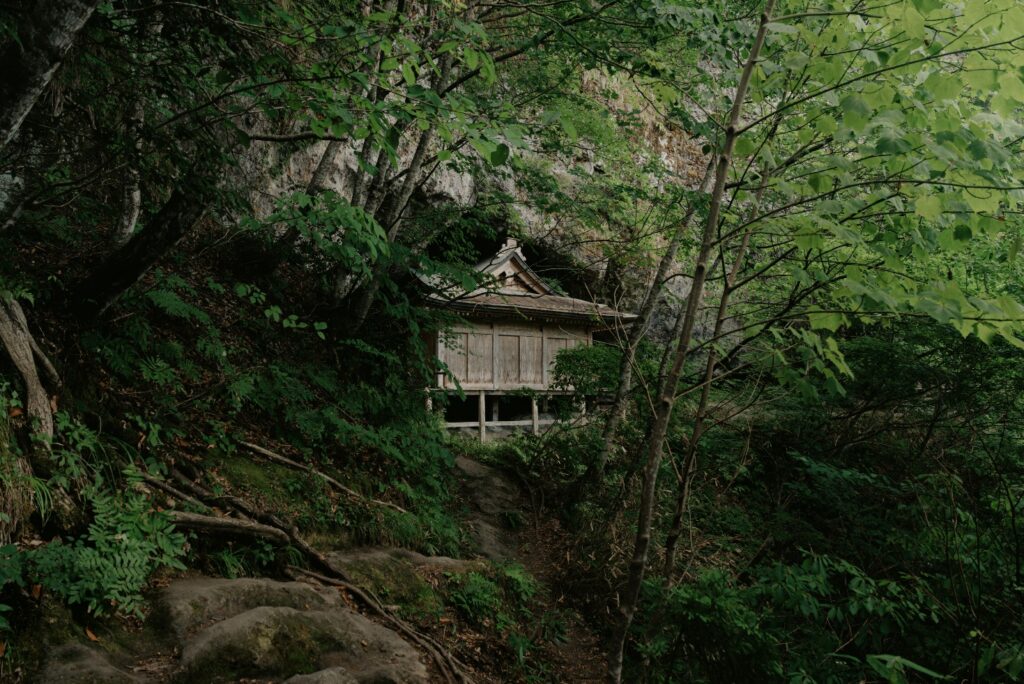
Just after Kannon-do is Motoyui-kake-do, a significantly smaller and well-worn wooden structure adorned with a small lone bell, at which, in the past, pilgrims would cut and dedicate their hair. I don’t notice any locks as I pass by, but you never know…
Rounding the corner and proceeding just a bit further, it finally comes into view—Sanbutsu-ji’s seventh and final “inner” hall, or okunoin, Nageiredo.
“Oh, my god!” breathes Haruka just behind me.
I’ve never given much credence to Japanese “power spots,” but I feel like if any place is worth the description, it’s Nageiredo. Hearsay and photographs don’t quite convey just how striking it is, perched on slender wooden beams that seem to simply rest on some of the small, flatter sections of the mountain’s otherwise very steep, rocky face.
It’s hard to fathom just how it could have been constructed—especially almost a thousand years ago. Perhaps even more astonishing is that it has apparently never needed to be rebuilt. And this is in a country that experiences an average of fifteen hundred earthquakes per year. A quick Google search tells me that the Chugoku Region is one of the least seismically active areas in Japan, so there’s that, but nonetheless, there have been at least three major earthquakes in the region since the temple’s construction.
And yet, it still stands.
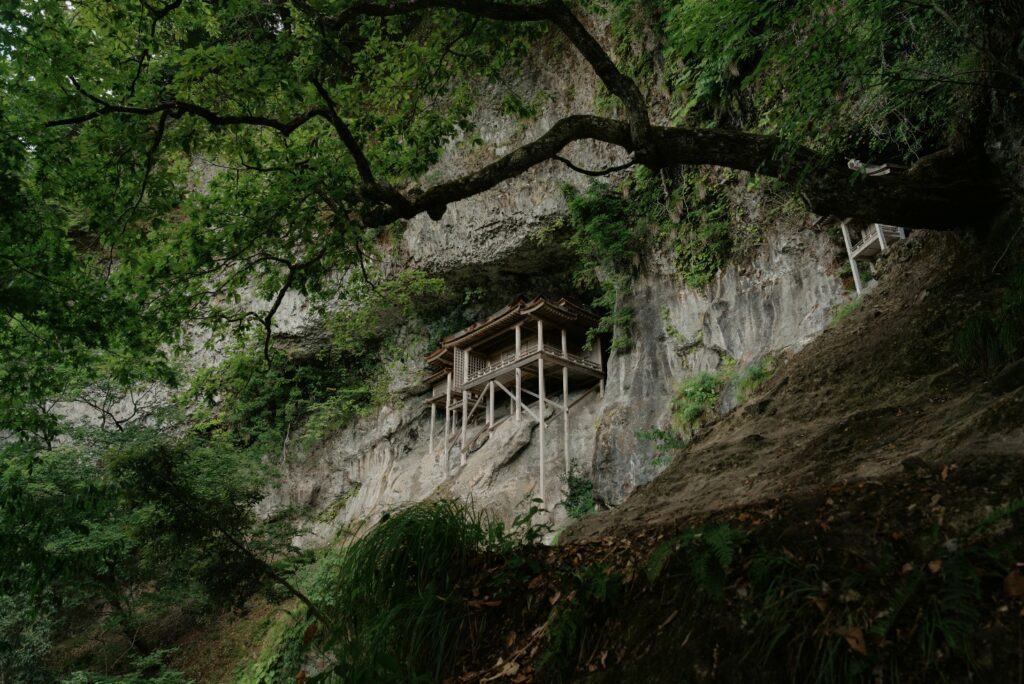
A marvel of engineering, one might say, but according to legend, it came into being in the 7th century when the founder of Shugendo literally flung the already-built structure into the side of the mountain. It’s for this tale that Nageiredo is named, translating directly to “thrown-in hall.” Of course, the scientific process of tree-ring dating indicates that the actual construction occurred sometime in the late eleventh century, but this does nothing to dispute the method by which the materials were placed—or tossed.
A question I had for Yoneda-san before the hike was about the purpose of such a structure. Surely no one has actually been able to make their way onto Nageiredo’s balcony, at least not in recent centuries?
“If the purpose had simply been to allow people to enter and worship inside, there would have been no reason to build it in such an inaccessible place,” he answered. “It could have been constructed on flat ground,” with the implication being that Nageiredo was not created to be a place for people, but rather for the deities that are enshrined there.
Whatever its true origins and purpose may be, this “thrown-in hall” remains an architectural mystery and a truly stunning view.
The descent isn’t much different than the way up, though I often find myself handling the steeper sections by sliding my posterior against the stones and soil in a semi-crab walk. As with the ascent, the hardest part is once again the area just below Monju-do. My elbows and forearms grind against the rocky surface as I climb down several long rust-coloured chains.
And at last, over two hours since the pilgrimage began, Haruka and I find ourselves crossing the threshold of kekkai-mon, back into this mortal realm, a little wiser maybe, and definitely much, much more exhausted, quads having turned into a jelly or fine paste.
And you know what? I really, really want to do it again. Just not in the sweltering humidity of summer.
On the way back to the car, I stop at the sub-temple Kaijo-in to collect Sanbutsu-ji’s goshuin. A goshuin, which is a custom dating back to the Nara period, is a page on which a temple’s unique seal is stamped, followed by hand-brushed calligraphy detailing the temple and date. Initially given as a receipt to worshippers for transcribing Buddhist scripture, the custom has evolved to serve as a record or spiritual token of one’s visit. Ever since I started collecting them in 2017, it’s become a necessity when visiting any significant temple or shrine and getting one from Sanbutsu-ji was absolutely vital.
Even now, I have to tell myself that I didn’t “conquer” that ancient trail. (Nor did it conquer me, thankfully, for I seem to still be alive.) No, as Yoneda-san clarified before the climb, the strenuous journey is not about conquest, but about meditation and spiritual purification.
Well, it’s definitely one of the physically hardest things I’ve ever done, but I hope that I get another chance to meditate in this way.
My sopping wet clothes are draped over my luggage in the backseat as the car pulls out of Sanbutsu-ji’s parking lot. I’m down to my last clean top—a twenty-year-old cutoff typically reserved for the gym. This is what summer in Japan is like for a born-and-bred Canadian; damp and oh so smelly. I guzzle down the last of the two-liter bottle of lukewarm water left over from yesterday.
We’re on our way to an historic city located in central Tottori, just twenty-five minutes away by car—or approximately fifty-five by bus, with one transfer. The road into town is a picturesque one, lined with trees. The streets are wide, the pavement flanked by spacious sidewalks, and the buildings are low, with many of them looking well weathered by the decades.
Kurayoshi is an old castle town (sans-castle these days) famous for its traditional merchant quarters and historic Edo-period white-walled storehouses that, like Nageiredo, have evidently changed very little since they were erected.

We find ample parking at the north end of Utsubuki Koen-Dori Street in the Meiji-cho Tourist Parking Lot, across from a black steam engine and quaint, pink police station.
I have a hankering for tempura and noodles, but there’s not much open past one or two p.m. Countryside means slow living and slow living means siestas. Looking around at how empty the roads and sidewalks are, it’s hard to fault the locals. However, as luck would have it, just a short walk from the parking lot is Nakamura, an udon restaurant that operates only at lunch time, but just so happens to remain open until half past two. Score.
Nakamura is housed in a quaint, traditional building. Its design is what I think of as “Japanese tudor”— white exterior walls framed by dark wooden gridwork, all topped with grey shingles. The construction may not date to the Meiji or Edo period, but the design certainly does.
After the blinding sunlight outside, the interior seems dim. My eyes adjust and I see a space that is quintessentially Japanese—beige walls, unstained wood accents, ornamental shoji windows, a maneki-neko and the same analog wall clock found in virtually every Japanese establishment built and designed prior to my conception.
It’s homey. Not exactly what I’d call photogenic, but comfortable.
I don’t know if Kurayoshi sees much of a lunch rush on weekdays, but if they do, we’ve missed it. Just two of Nakamura’s six tables are occupied, one by a trio and the other by a lone elderly fellow facing the kitchen and having a chat with the staff. Haruka and I are seated at the table opposite and are served by a couple so aged that I have to wonder if they were there when the storehouses were built.
I order the ebi-tempura udon set and the staff, a couple whom I assume are also the owners, busy themselves in the otherwise empty kitchen. After a few minutes, the chap across from us gets up and moves behind me, emerging a moment later with two cups of water, which he places on our table while saying “water.” I’m impressed and touched that a local would take care to see that we’re served—that is, until he goes into the kitchen and I realize that he must also work here, or at least, be so close with the owners that he’s a de facto part-timer.
Probably not even ten minutes later, my lunch arrives and I’m greeted by a pile of noodles and the two largest prawn tempura I’ve ever seen. I dig in and quickly learn that they’re also the most delicious prawn tempura I’ve ever eaten, with perfectly meaty, juicy texture. After the morning’s brutal climb, it is a very, very satisfying lunch. And also remarkably affordable.
Nakamura is a restaurant from a bygone era, with portions and prices from a bygone era; an era that hasn’t become familiar with words like “recession” and “inflation.” An era that doesn’t know how pitifully weak the yen’s been for the past few years. I savour it all; the dish, the price and the atmosphere.
After filling our bellies and paying in cash—because of course a place like this is cash-only—we head back out into the sweltering heat.
It’s time for beer.

Because that’s actually what led me to find Kurayoshi and the reason I had requested to stop here. I make an effort to visit a local craft beer place wherever I go whenever possible. When I first came to Japan some ten or so years ago, the words “craft beer” didn’t mean much to many people, whether pronounced in English or katakana. That’s changed in a big way.
Founded in 2019, BrewLab Kurayoshi is one of only a handful of craft breweries in Tottori.
On our way there, we pass Kurayoshi’s famed Shirakabe (white-walled) warehouses on a street that bisects the city, east to west. This narrow road shares space with a slightly narrower canal, over which sit many small stone bridges, leading into the businesses and dwellings that now occupy the space. I saw online that these waterways are said to contain some beautiful carp, but today, I sadly don’t see any.
Located the next block over is BrewLab Kurayoshi. With its pale yellow facade and rust-coloured shingled roof, it looks more like a local folk and heritage museum instead of a house of beer. In fact, as we’d soon find out, the building started not as a brewery but as a wartime hospital and now, protected by local heritage laws, its quaint, vintage facade serves as an architectural reminder of the westernization of Meiji-era Japan.
We’re greeted at the entrance by founder and owner, Fukui Tsunemi, a certified badass with his black bandana, camouflage cargo shorts, grey goatee and immensely cheerful smile. Inside, we meet Fukui-san’s wife Chigusa, who helps run the business, as well as head brewer Kitachu Yuta, who sports a great beard and cap featuring an embroidered illustration of the original 1979 Gundam. You couldn’t ask for a better trio.

I eagerly scan the beer menu and am very pleased to see a whopping nine beers, and not one of them a boring ol’ lager. (Look at me, carrying on in my 2012-PNW-hipster ways.) I start with the west coast style IPA—because of course I do. IPAs are the perfect beer for summer, especially those of the hazy and/or juicy variety. The full-bodied blend of sweet citrus and dry bitterness is nothing if not refreshing. Brew Lab’s is an opaque orange and goes down silky smooth. Absolute perfection. I’m grinning ear to ear. You could put me in a beer commercial with utterly authentic sighs of satisfaction and exclamations of “oishi,” no acting needed.
As I attempt to politely sip (instead of guzzling it down and immediately ordering another), Fukui-san talks about how he got into the business and how this brewery started. He was inspired to enter the beer business after learning about the achievements of Kurayoshi City’s first honorary citizen, Isono Chozo, who served as Kirin Brewery’s president and chairman in the forties and fifties. For Fukui-san, this means that BrewLab connects Kurayoshi’s history with modern craft beer culture, carrying the city’s historical connection to the country’s beer industry into the present day. He also makes an effort to ensure BrewLab’s beer production is a sustainable part of the local economy, providing nutritious spent malt to a local free-range poultry farm as chicken feed. In return, the brewery receives fresh eggs from the farm, which are then used in dishes served at the shop.

For my second drink, I select the limited Hoshizora Ale, a rice beer with a malty base and rather bitter, hoppy finish, which gets its name from Tottori Prefecture's brand-name rice, Hoshizora Mai, with which the beer is crafted. It’s good, though if I were forced to choose, the IPA is a better choice for me, at least given the season.
We take a few photos together for BrewLab’s Instagram and then Haruka and I are off. I wish I had more time in Kurayoshi so I could visit the Museum of History and Folklore, the Tottori Prefectural Museum of Art and Utsubuki Park, but alas, we’re on a schedule.
Next up—onsen.
It’s only after my brief single-night stay that I learn that the town was christened Misasa (which means “three mornings”) because visitors who remain in the town and enjoy its renowned hot springs three mornings in a row come away cured of all afflictions. Local legend or masterful marketing? Perhaps a bit of both.
Just a stone’s throw away from Mitoku-zan, Misasa is a resort town in central Tottori. The Mitoku River runs through the town and almost two dozen ryokan flank its banks, all fed by over one hundred hot spring sources that have been utilized for some 850 years.
Misasa’s onsen contain some of the highest radon contents in the world and locals say it has excellent healing effects on one’s body and mind, though I don’t know that there’s any hard science backing this up. (It may depend on the manner of exposure, but as far as I know, radon is considered to be harmful.) Nonetheless, that’s why people have been making the journey to the town for the past several centuries. At least it doesn’t reek of sulphur.
Like the nearby Mitoku-zan, Misasa doesn’t have its own railway service and the closest station is actually Kurayoshi Station, an hour and a half’s walk west. The most direct bus ride from Kurayoshi Station to Misasa is twenty minutes, though this route only operates once every hour or so. Once again, I’m thankful to be travelling by car.
I would be spending the night alone at the aptly named Misasa-kan, a beautiful ryokan fed by one of the largest amounts of hot spring water in the town. It would probably sound like a generic travel brochure if I were to say that the staff embodies the very spirit of hospitality, but it also wouldn’t be inaccurate. They’re exceptionally friendly. Misasa-kan has somewhere in the ballpark of seventy or eighty rooms, some more traditional, others more modern. I’m thankful to be granted a surprisingly spacious two-bed room. No futon or sore lower back for me!

After getting settled, a staff member guides me to the private open-air Tamayura bath—reservations only. From what I gather, the tub is made of Japanese cypress, providing a subtly pleasant scent.
I ‘d like to just shut my eyes, listen to the sound of the water continuously rushing down the flat wooden faucet, and drift off into a thoughtless reverie while soaking my poor aching feet. I have company, however. Company in the form of critters. Two slender, stunning black dragonflies of a kind that I’ve never seen rest on the moss just outside the bathing area and I have to inspect them more closely. A quick search tells me these are hagurotonbo and their immensely large, shiny eyes are just plain cute. What a find. I glance back at the clock and see that I have just a few minutes to rinse myself off and get dressed. Bummer.

Having wrapped myself in a hotel yukata in a way that only an amateur can, I make my way to Misasa-kan’s dinner quarters, where a private dining room awaits. Inside, there’s quite a spread elegantly laid out before me. Kaiseki-ryouri describes a traditional and often luxurious multi-course Japanese dinner. I always marvel at the variety. Individually, each dish looks like a small portion, but every time, it adds up to a very full me. This time, the dinner consists of an assortment of sashimi, puddings and soups, and one of my favourite Japanese dishes, kakuni, as well as my other favourite, sukiyaki, with the star being a perfectly marbled cut of Tottori wagyu. Time for another beer! A bottle of Kirin, in honour of Tottori’s own Isono Chozo, of course.


Belly full and palate satisfied, I waddle back to my room to grab my tripod and another lens. Incidentally, there’s a fireworks display in town this very night.
The Misasa Onsen summer fireworks occur on certain dates throughout the months of July and August and, as Haruka heard from the “proprietress of the inn”—her words—the tradition is meant to be a prayer that wards off plague. I feel lucky that my stay just so happens to coincide with one of these nights. Kawaga Bridge, conveniently located directly in front of the hotel, should be a more-than-adequate vantage point. I’m utterly exhausted, yes, but I haven’t seen fireworks since 2015 or 2016 and there’s no way I can pass it up. The spectacle will only last five minutes anyways, so it’s not like it requires a great amount of effort on my part.

Not long after, I find myself on the bridge, camera ready, amidst several yukata-clad families. The fireworks begin right on schedule and culminate in a spectacular explosion of colour. The show is short and sweet. A perfect way to end the day. My smartphone’s native health app tells me I’ve walked 8000 steps and climbed 58 flights. My camera tells me I’ve shot over 900 photos. It’s finally time for bed. Otsukare.

It’s seven a.m. and the breakfast buffet is swarming with families, and there seems to be just as many grade-school aged kids as adults, so I know that queuing up is futile. Even in Japan, when young kids are involved, it’s first come, first serve. That’s one thing to make note of, actually—Misasa-kan has quite a family-friendly environment, which probably isn’t ideal for a solo traveller, couple seeking romance, or light sleeper. But if you’re coming with kids, I can’t imagine a better choice. Either way, given how busy the inn is, I think I was lucky to get a room at such short notice. For international visitors, I wouldn’t usually recommend travelling throughout the country during the first half of August when Obon takes place.

After breakfast, I have some time to spare, so I decide to take a quick stroll around Misasa.
Shortly after emerging from the hotel, I’m greeted with a confident “hello.” I turn and find myself face to face with a tall, slender Japanese youth in athletic attire. He appears to have stopped in the middle of his morning run to say hi. How is he so dry? I’ve been outside for just a couple of minutes and my top is already becoming damp. Sorcery.
He introduces himself and tells me he’s a university student from the area. He asks me where I’m from and how I’m enjoying Tottori. There’s the usual back-and-forth and shortly after, I thank him for the brief conversation and he resumes running. What I wouldn’t give to maintain dry, odourless clothes during this season, whether engaging in physical activity or not…
Anyways, it’s been quite some time since someone has tried to practice English with me. When it’s this rare, it honestly feels quite nice. Living in Tokyo, where there’s tourists and foreign residents in abundance, and a large chunk of the local population seems to be either indifferent to, or utterly sick of us, it’s easy to forget that friendly encounters can occur. Another thing to like about Tottori.
I continue exploring, crossing the bridge and strolling down the riverside road, shaded by a canopy of dense greenery above. It’s quiet but for the ever-present chorus of cicadas. On the other side of the town, I meander about the mostly empty, noiseless streets, gazing at shuttered shops and elderly residents watering their plants, each scene painted with the hard shadows of the morning sunlight. Nothing is happening… …and it’s perfect.
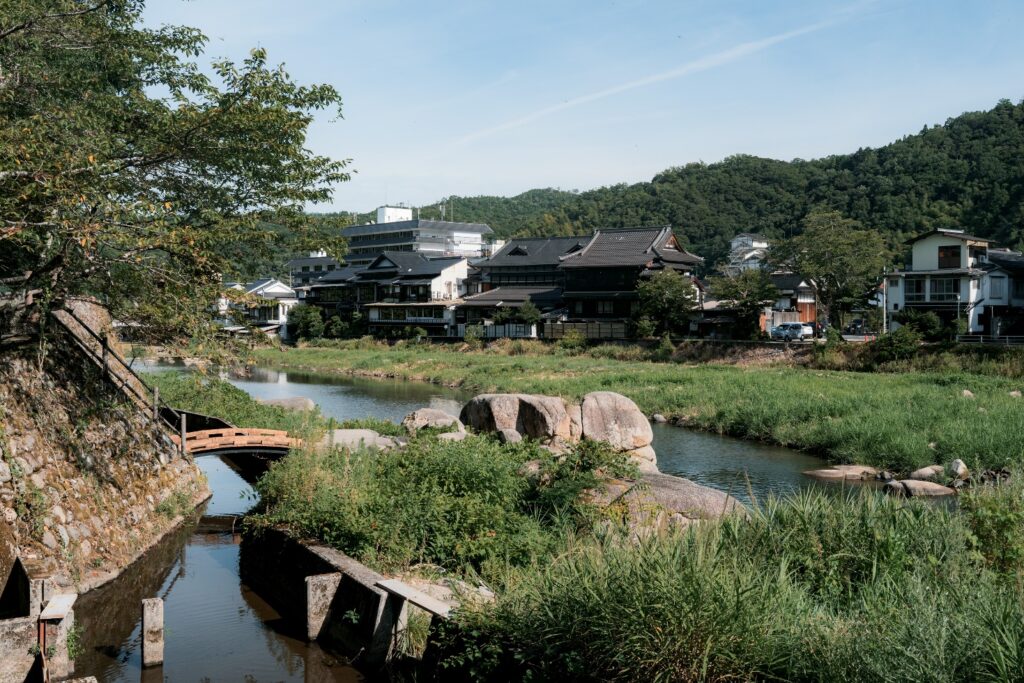
Unfortunately, I’m made to abandon the quiet moment when I see the time. As always, duty calls. On the way back to the hotel, I’m suddenly struck by the apparent accessibility of the beautifully blue Mitoku River. You can just wander off the path and into the tall grass and rocks for a closer look. In my experience, even on the most rural hiking trails in the Tokyo area, paths are linear and restrictive. Similarly, in the big city, there’s virtually no access to rivers—not that you’d want it though, given how brown and murky the waters are. In Tottori, on the other hand, there’s a sense of freedom, approachability and authenticity all around the prefecture; the riverbanks here in Misasa, the unkempt trail leading up and through the cliffs of the Uradome coast, and of course, the dangerous, winding route to Nageiredo. And in all these places, you encounter cobwebs and all manner of critters, (my boonie hat is still adorned with the former,) as though people are just temporarily passing through and borrowing bits of the space. It stands in stark contrast to the sterility that’s ever present in so much of the big, modern city.
This thought helps give shape to the feeling I’ve had since arriving two days ago.
I admire the old houses, the overgrown paths and the untamed greenery. I admire the way nature seems to reclaim some of the older, unoccupied buildings. These residences are still inhabited; just not by people. Maybe I made a mistake opting to live in Tokyo from the beginning. I don’t know if I could have properly put down roots in a place like Tottori. Not then. But I think it may have been able to put some of its roots in me.
But that’s all in the past; “dust in the wind,” as the song goes. I’ve been fortunate enough to have the opportunity to come here and I’m tremendously thankful for it. Now, bound for the airport and the inevitable return to my regular routine, I’m already thinking about my next visit. I don’t know if I’d choose summer again, but I certainly hope I have the chance to return to Tottori.
On the way to the airport, Haruka and I pass the Hakuto Coast beach and I see a small torii gate erected on a large rocky outcropping a couple hundred meters from the shore. We’ve still got a bit of time, so I ask her to make a quick stop. It never ends, does it? There’s always something to discover.
